Pixel Art Still Has New Tricks
Pixel art has moved far beyond recreating the appearance of old console games.
Modern independent developers use it to build atmospheric horror adventures, energetic action games, relaxing simulations, and strange experimental worlds.
That versatility is especially visible in October 2026.
This month's selection includes a pig cleaning a pixelated town, a survival-horror mystery with live-action sequences, a fish-breeding sandbox, and a colorful action roguelike.
They have very little in common beyond their broad visual inspiration.
And that's precisely what makes them interesting.
For Retro Nation readers, the attraction is discovering games that deliver memorable ideas without relying solely on expensive production values.
Here are four worth investigating this October.
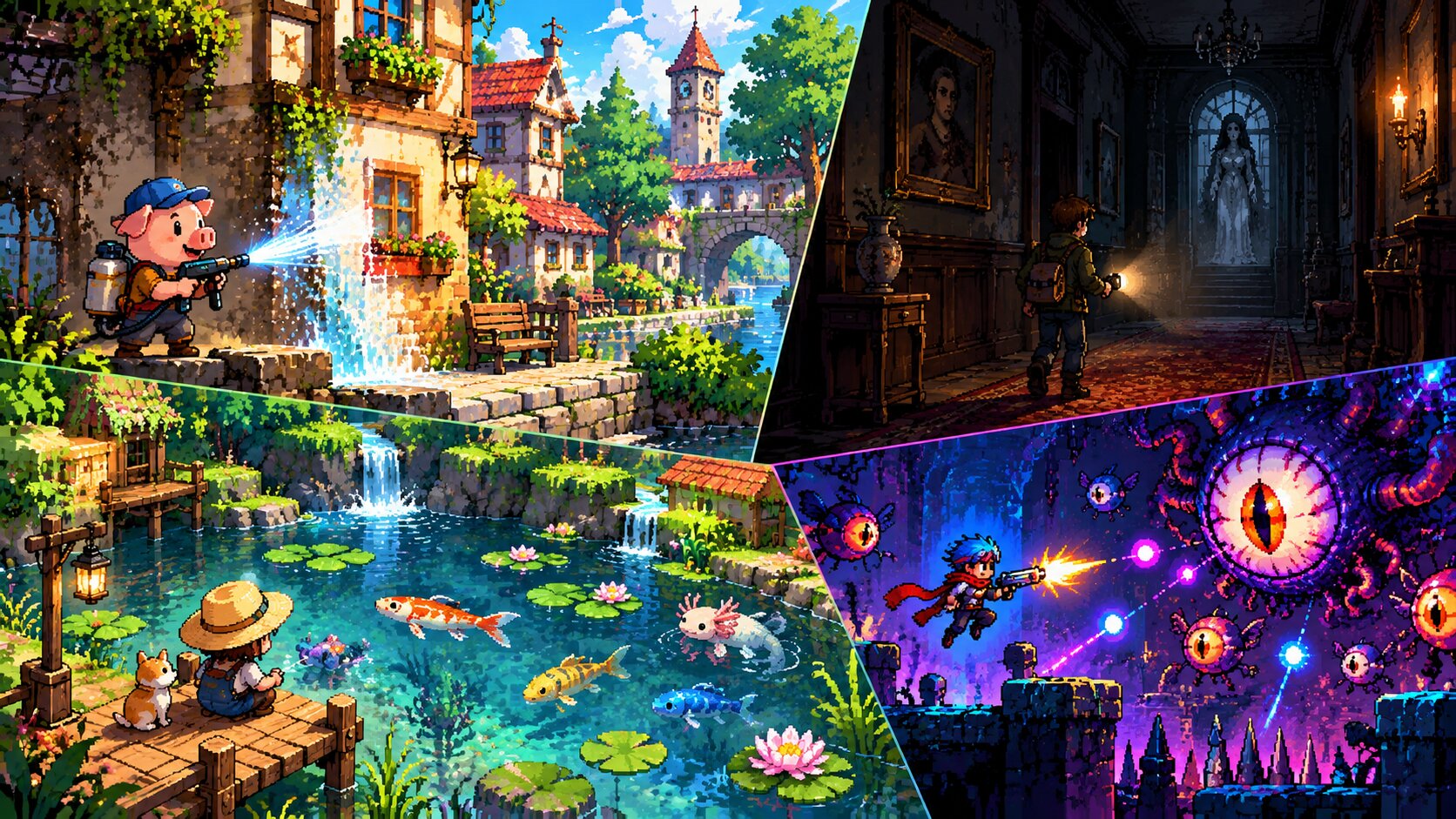
Four Different Ways to Use Pixels
| Game | October Status | Main Appeal |
|---|---|---|
| Pixel Washer | Early Access, October 15 | Relaxing cleaning simulation |
| Tenebris Somnia | October 16 listed release | Retro survival horror |
| Retro Pond | Planned October 22 | Fish breeding and pond customization |
| Neon Abyss 2 | Existing Early Access title, October 1.0 coverage | Action roguelike |
These aren't ranked from best to worst.
Each represents a different reason to enjoy pixel-inspired games.
Players who want something calm may find themselves drawn to Pixel Washer or Retro Pond.
Those looking for tension or action have very different alternatives in Tenebris Somnia and Neon Abyss 2.
Pixel Washer: Cleaning Up a Colorful World
An Unusual Way to Reveal Pixel Art
Sometimes a game has a concept so immediately understandable that it hardly needs an introduction.
In Pixel Washer, you play as an adorable pig equipped with a power washer.
Your objective is to clean dirt and grime from colorful environments, gradually revealing the artwork hidden underneath.
The developer, Valadria, combines casual cleaning mechanics with upgrades and environmental exploration.
Players earn coins, improve their equipment, and work through different areas of a dirty town.
Cleaning may involve removing ordinary mud, slime, or other substances. Some areas also contain puzzles or hidden surprises.
The central appeal is the transformation itself.
A dirty environment becomes an attractive pixel-art scene through the player's actions.
It's a satisfying concept because the reward is visible throughout the process rather than only at the end.
Who Should Watch It?
Pixel Washer appears particularly suitable for players who enjoy:
- Relaxing activities.
- Incremental equipment upgrades.
- Colorful 2D worlds.
- Low-pressure exploration.
- Games with straightforward objectives.
It entered Steam Early Access on October 15, 2026.
That distinction matters. The core experience is playable, but the developer plans to expand and refine the game before a full release.
Hardware note: Its published minimum requirements include 4 GB RAM and Intel UHD 620 or Radeon Vega 8 graphics or newer.
That makes it worth investigating for some everyday PCs, though actual performance depends on the complete system.
Before buying: Decide whether you enjoy repeated cleaning activities enough to sustain interest beyond the initial novelty.
Tenebris Somnia: Horror Beyond the Pixels
When Retro Graphics Meet Live Action
Tenebris Somnia takes a very different approach.
Developed by Andrés Borghi and Saibot Studios, this survival-horror adventure combines a classic 2D visual style with live-action cinematic sequences.
The result is an unusual contrast between two different presentations.
During gameplay, players explore environments, investigate mysteries, solve puzzles, and confront dangerous creatures.
At important narrative moments, the game shifts into footage featuring real actors and practical effects.
Those transitions are central to its identity.
Rather than simply celebrating 8-bit or 16-bit aesthetics, Tenebris Somnia uses that visual language alongside film techniques.
For horror fans, the contrast could make certain moments especially unsettling.
Why It Stands Out
Retro-inspired horror is hardly new.
What distinguishes this project is its ambition to connect traditional survival-horror mechanics with independently produced live-action filmmaking.
The developers emphasize mystery, exploration, combat, and cinematic storytelling.
Its listed release date is October 16, 2026. The Steam listing also offers a demo, though store availability should be checked directly.
Who Should Watch It?
Consider Tenebris Somnia if you enjoy:
- Classic survival horror.
- Puzzle solving.
- Atmospheric mysteries.
- Unusual cinematic presentation.
- Retro visuals with modern storytelling techniques.
Hardware warning: Don't assume the pixel-art appearance means low requirements.
The published minimum includes 8 GB RAM and a graphics processor with 4 GB VRAM.
That's a meaningful requirement for anyone using an inexpensive computer with older integrated graphics.
Before buying: Confirm compatibility and decide whether the combination of survival horror and live-action sequences suits your preferences.
Retro Pond: A Tiny World of Possibilities
Build a Pond, Then See What Happens
Retro Pond is built around an entirely different kind of creativity.
Developed by msky, this pixel-art simulation lets players design ponds, breed fish, discover mutations, and participate in competitions.
The concept sounds simple, but its systems introduce several possibilities.
Players can decorate their ponds, experiment with fish combinations, discover unusual variations, and customize their collections.
According to its Steam description, the game includes more than 100 decorations across three themes and over 70 rare mutations and ability cards.
Fish also have personalities, with optional locally generated dialogue.
The developer states that the dialogue feature uses a small local language model and can be disabled without preventing progress.
That is an unusual feature worth understanding before playing.
Why It Deserves Attention
Retro Pond treats its pixel-art environment as a small world that players can shape.
Instead of competing through reflexes or combat, players experiment with combinations and collections.
There's an interesting distinction between a game that gives you a world to explore and one that lets you gradually create your own.
Retro Pond leans toward the latter.
Who Should Watch It?
This looks particularly interesting for:
- Sandbox enthusiasts.
- Players who enjoy collecting unusual creatures.
- Fans of cozy simulation.
- People who prefer experimentation over combat.
- Players interested in compact, customizable game worlds.
The planned release date is October 22, 2026, and Steam lists a playable demo.
Its published minimum requirements include 600 MB RAM, a 2 GHz processor, and compatible OpenGL or Vulkan graphics.
Those specifications look modest, but they don't guarantee performance on every older computer.
Before buying: Try the demo and decide whether breeding, customization, and collecting provide enough variety for your preferences.
Neon Abyss 2: Arcade Action Reimagined
For Players Who Want Something Faster
Not every pixel-art game needs to be relaxing.
Neon Abyss 2 takes the visual approach into fast-moving action-roguelike territory.
The game builds upon the original Neon Abyss with colorful combat, randomized challenges, character progression, and increasingly elaborate combinations of equipment and abilities.
Rather than following a single linear adventure, the roguelike structure encourages repeated attempts.
Players experiment with different combinations as they explore dangerous environments and encounter enemies.
That makes it substantially different from the other three games in this list.
Where Pixel Washer focuses on restoring environments, Neon Abyss 2 emphasizes movement, experimentation, and combat.
Why October Matters
Neon Abyss 2 entered Early Access before October 2026, so it should not be described as a completely new October debut.
October coverage has highlighted its move toward a fuller release.
Players should verify the latest release status and platform availability before purchasing.
Who Should Watch It?
Neon Abyss 2 is a better candidate for players interested in:
- Fast-paced action.
- Roguelike progression.
- Repeated runs.
- Equipment and ability combinations.
- Colorful retro-inspired visuals.
Before buying: Check whether the gameplay's speed, repetition, and difficulty suit you.
The vibrant presentation also shouldn't be mistaken for a guarantee of compatibility with low-end hardware.
Which Game Fits Your Taste?
The strongest choice depends on what you actually want to do.
| If You Enjoy… | Consider |
|---|---|
| Relaxing, repetitive tasks | Pixel Washer |
| Horror and investigation | Tenebris Somnia |
| Customization and collecting | Retro Pond |
| Fast action and repeated runs | Neon Abyss 2 |
There's no universal winner.
If you want to unwind after work, a horror adventure might be the wrong choice even if its visual style appeals to you.
Likewise, a relaxed pond-building game may not satisfy someone looking for precise controls and demanding combat.
Start with the gameplay activity, then evaluate the art style.
Don't Confuse Pixel Art With Low Requirements
One of the most common misconceptions about pixel-art games is that they all run on inexpensive or outdated computers.
That isn't necessarily true.
Modern pixel graphics can appear alongside demanding physics simulations, elaborate visual effects, complex lighting, or large numbers of animated objects.
Tenebris Somnia, for example, lists a graphics requirement that may exclude many older integrated-GPU laptops.
By comparison, the published requirements for Retro Pond are much lower.
Both games use pixel-inspired visuals, but their technical expectations are different.
Before purchasing, examine:
- Required operating system.
- Processor model or speed.
- Minimum RAM.
- Graphics hardware and supported APIs.
- Available storage.
- Demo availability.
A demo is especially valuable because it lets you investigate gameplay and performance before committing to a full purchase.
Even then, remember that a demo's performance is not a guarantee of final-release behavior.
What to Play or Wishlist Next
October 2026 offers an interesting cross-section of modern pixel-art game development.
Pixel Washer turns cleaning into visual discovery. Tenebris Somnia uses contrasting presentation techniques to support horror. Retro Pond builds a playful world around breeding and customization. Neon Abyss 2 brings pixel-inspired action into a colorful roguelike.
Each gives players a different reason to look beyond high-budget releases.
The most useful approach is simple: pick the game whose mechanics genuinely interest you, check whether your hardware supports it, and use a demo when available.
Great pixel art isn't merely about looking like an older game.
It's about using a distinctive visual language to create something worth playing today.
Frequently Asked Questions
Are pixel-art games always easier to run?
No. Performance depends on the game's technical implementation, not simply its visual style.
Which game looks best for relaxing play?
Pixel Washer and Retro Pond focus on lower-pressure activities, although their gameplay styles differ.
Which game is most suitable for horror fans?
Tenebris Somnia is explicitly designed as a survival-horror experience with puzzles and live-action sequences.
Should I buy an Early Access game immediately?
Only if its current playable content already appeals to you. Planned future improvements are not guaranteed.
By: Marco Medalla
Contributor: Retro Nation
Date: October 18, 2026
Disclosure: This is research-based discovery coverage. No personal gameplay, ownership, or benchmarking is claimed.
References
Game descriptions, release status, and technical requirements were obtained from the official Steam listings linked in the relevant sections. Availability and requirements may change.
0 comments:
Post a Comment