One Family, Two Different Approaches
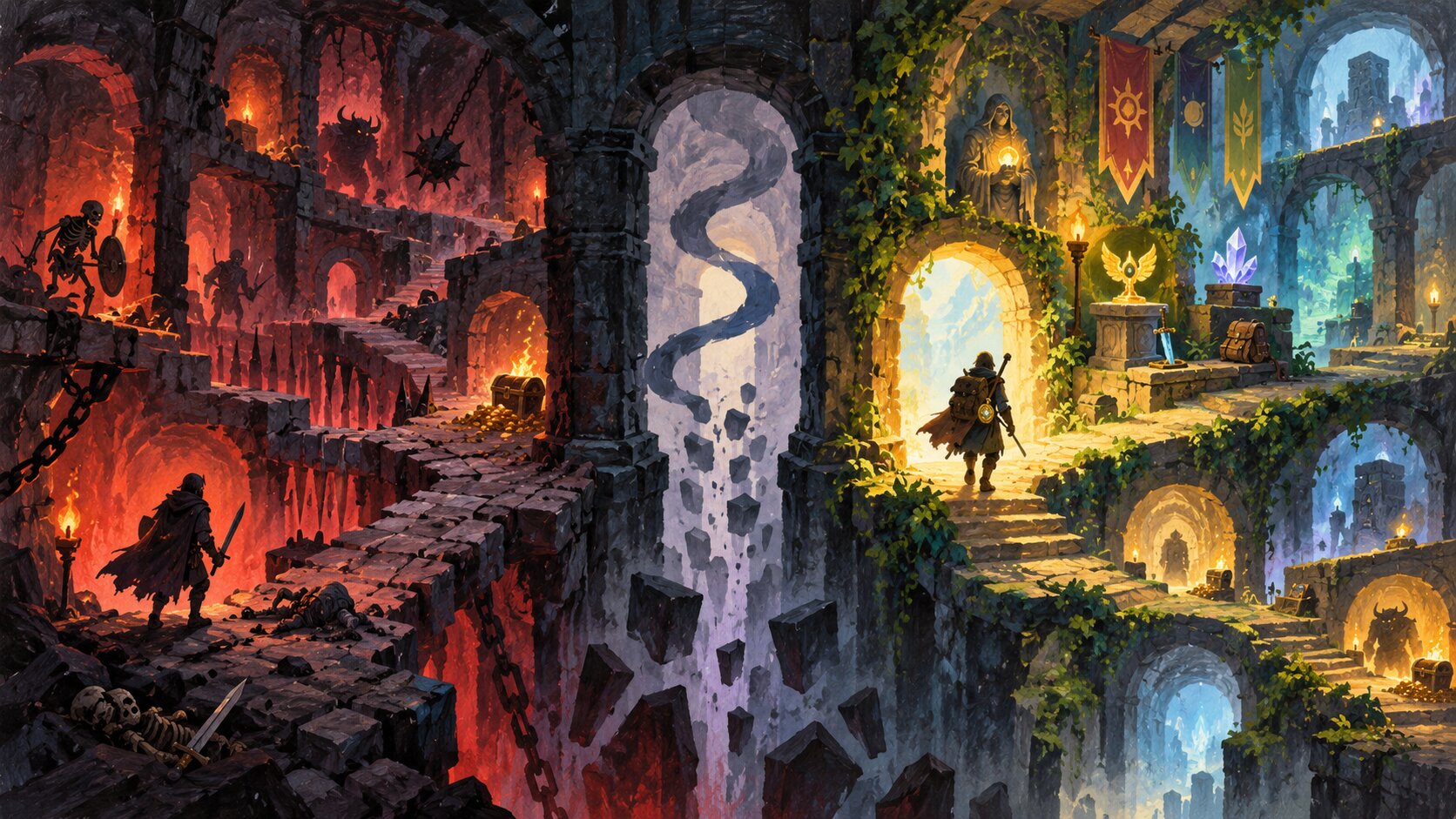
Imagine exploring a mysterious dungeon, discovering powerful equipment, and surviving several increasingly dangerous encounters.
Then your character dies.
In one game, almost everything you've collected disappears. You begin again with a new character, a new dungeon, and the knowledge gained from your previous attempt.
In another, you also restart, but some currency, upgrades, weapons, or story developments remain available.
Both experiences may be advertised as roguelikes. Yet they create very different expectations.
The terms roguelike and roguelite describe related approaches to game design built around repeated attempts, uncertainty, and learning through failure.
Understanding the differences can help you find indie games that match your patience, preferences, and available gaming time.
What Is a Traditional Roguelike?
The term roguelike comes from Rogue, the influential dungeon-crawling computer game released in 1980.
Rogue combined several features that later became closely associated with the genre:
- Procedurally generated dungeon environments.
- Turn-based movement and combat.
- Grid-based navigation.
- Randomly distributed items and enemies.
- Resource management.
- Permanent character death.
- A new adventure after losing a run.
Traditional roguelikes generally follow several of these principles closely.
Unlike games with frequent checkpoints, losing your character is part of the central design.
Learning Matters More Than Unlocking
A defining attraction of traditional roguelikes is that players improve through knowledge.
You learn which enemies are dangerous, when to retreat, which resources to preserve, and how seemingly minor decisions can have major consequences.
The next run might begin with similar basic opportunities, but you understand the game's systems better.
That personal improvement is itself a form of progression.
Examples of Traditional Roguelikes
Well-known examples include:
NetHack: A long-established dungeon crawler known for complex interactions, tactical decisions, and unexpected consequences.
Dungeon Crawl Stone Soup: A turn-based dungeon crawler focused on surviving randomized challenges through careful decision-making.
Brogue: A modernized interpretation of classic roguelike principles with accessible presentation and demanding tactical depth.
These games demonstrate how a relatively simple visual presentation can support substantial mechanical complexity.
They also show why traditional roguelikes remain relevant to players interested in deep gameplay rather than expensive graphics.
What Makes a Game a Roguelite?
Roguelites borrow important elements from roguelikes but adapt them to different gameplay styles.
Many retain repeated runs, randomized elements, and the possibility of losing progress when the character dies.
However, they may include features such as:
- Real-time action combat.
- Platforming mechanics.
- Deck-building systems.
- Permanent character upgrades.
- Unlockable weapons or abilities.
- Story progression between attempts.
- Persistent currencies or resources.
A roguelite doesn't necessarily include every feature.
The important idea is that the game adapts the traditional run-based structure rather than reproducing the original formula exactly.
Progress That Survives Failure
One common distinction is persistent progression, often called meta-progression.
Imagine completing a difficult run and collecting a special resource.
Your character eventually dies, but you keep that resource.
Back at the starting area, you spend it on an upgrade that influences future attempts.
The next run remains unpredictable, but your overall game progress hasn't completely disappeared.
This can make repeated failure feel more rewarding.
It also creates a different relationship between player skill and character power.
Roguelites Can Still Be Difficult
Persistent upgrades do not automatically make a game easy.
Developers may balance later encounters around stronger characters or require players to master demanding movement and combat systems.
Some roguelites preserve new gameplay options without substantially increasing the player's starting power.
Others rely heavily on permanent statistical upgrades.
That's why understanding the specific progression system is more useful than assuming every roguelite follows the same difficulty curve.
Roguelike vs. Roguelite at a Glance
| Feature | Traditional roguelike | Modern roguelite |
|---|---|---|
| Repeated runs | Core | Common |
| Procedural generation | Central | Very common |
| Permadeath | Typically fundamental | Frequently used |
| Turn-based gameplay | Traditional standard | Optional |
| Grid-based movement | Common | Optional |
| Persistent upgrades | Usually limited or absent | Common |
| Real-time action | Less traditional | Very common |
| Main progression | Knowledge and mastery | Mastery plus possible unlocks |
| Genre combinations | Often dungeon-crawling RPGs | Action, cards, platforming, shooters, and more |
These are descriptive tendencies, not universal requirements.
Modern games frequently combine elements from both categories.
Storefront tags may use the broad term "roguelike" even when the game's mechanics fit a narrower definition of roguelite.
Understanding Permadeath and Procedural Generation
Two concepts appear repeatedly in discussions about both genres.
What Does Permadeath Mean?
Permadeath means that character death has consequences that cannot simply be reversed through an ordinary checkpoint reload.
In a traditional roguelike, losing a run typically means beginning a new character or adventure.
In a roguelite, the current run may end permanently while some progress remains attached to the overall player profile.
Consider two imaginary games.
In the first, you explore ten dungeon floors, defeat several bosses, and lose everything when your character dies.
In the second, your character also loses the current dungeon run, but you retain a permanent weapon unlock.
Both use meaningful consequences for failure.
The difference is how much progress survives.
What Is Procedural Generation?
Procedural generation uses rules and algorithms to create or rearrange game content.
Depending on the game, it might determine:
- Dungeon layouts.
- Room arrangements.
- Enemy placement.
- Item distribution.
- Environmental variations.
- Encounter combinations.
This is one reason repeated runs can feel different.
However, procedural generation does not necessarily mean that an entire game world is completely random.
Developers frequently combine handcrafted rooms or encounters with randomized layouts.
Randomness Does Not Replace Design
A game with random levels can still be poorly balanced or repetitive.
Good procedural design provides meaningful variation while preserving recognizable rules.
Players should gradually become better at identifying threats, making decisions, and adapting to new circumstances.
If random outcomes consistently overwhelm player decisions, replayability may become frustrating instead of satisfying.
Why Permanent Progression Changes Everything
Persistent progression influences how players think about failure.
The Traditional Roguelike Experience
Suppose you spend forty minutes navigating a dungeon.
Your character dies after making a risky decision.
You return to the beginning without a permanent character upgrade.
The reward is what you learned.
Perhaps you'll recognize a dangerous enemy earlier next time or understand when to conserve healing resources.
Progress is primarily personal.
The Roguelite Experience
Now imagine a forty-minute run that ends in defeat.
This time, you've earned a resource that can unlock a new weapon or character improvement.
Your next attempt benefits from both your increased understanding and the game's persistent systems.
The reward is partly personal and partly mechanical.
Which Approach Is Better?
Neither is objectively superior.
Traditional roguelikes can appeal to players who value consistency, strategic depth, and self-improvement.
Roguelites can appeal to players who enjoy unlocking possibilities and seeing their overall progress develop across many sessions.
Both can reward patience.
The more useful question is whether you enjoy beginning again with mostly the same capabilities or prefer retaining something after each attempt.
Popular Games That Help Explain the Difference
Modern examples demonstrate why genre labels can become confusing.
Hades: Action Roguelite with Story Progression
Hades combines fast-paced action, repeated escape attempts, persistent progression, and narrative developments.
Players return to a central hub between attempts, where important elements of the broader experience can continue advancing.
This structure helps explain why a roguelite can make repeated failure part of its storytelling.
It also shows that persistent upgrades and challenging combat can coexist.
Dead Cells: Fast Action and Unlockable Possibilities
Dead Cells combines side-scrolling combat, changing runs, weapon variety, and permanent unlock systems.
Its real-time combat distinguishes it from the traditional turn-based dungeon-crawling model.
Players gradually expand available possibilities while still needing to perform successfully during individual runs.
Rogue Legacy: Progress Across Generations
Rogue Legacy is an especially useful example of progression between runs.
Characters die, but the broader family progression system allows important upgrades to carry forward.
This changes the experience from a strictly fresh challenge into an ongoing development process.
Spelunky: A Useful Genre Boundary Case
Spelunky demonstrates why the labels aren't always straightforward.
It emphasizes randomized environments, demanding runs, and player mastery.
However, its platforming mechanics differ considerably from classic grid-based, turn-based roguelikes.
Some players classify it as a roguelite because of those differences, while others emphasize its roguelike design principles.
This disagreement is a reminder that genre labels describe families of mechanics rather than strict technical certifications.
Which Style Should You Choose?
Start with your preferred gameplay experience.
Choose a Traditional Roguelike If You Enjoy:
- Turn-based strategy.
- Carefully managing limited resources.
- High-stakes decisions.
- Learning intricate systems.
- Starting fresh after failure.
- Deep mechanics without requiring elaborate graphics.
Traditional roguelikes can be particularly appealing if you enjoy thinking through encounters rather than relying on fast reactions.
Choose a Roguelite If You Prefer:
- Real-time combat or platforming.
- Unlocking new characters or equipment.
- Seeing progress between attempts.
- Short sessions built around repeated runs.
- Mixing roguelike mechanics with other genres.
- Story developments linked to repeated play.
Roguelites are especially varied because the structure works with so many other gameplay styles.
Consider the Length of Each Run
A game built around short attempts may work well for brief gaming sessions.
Another might require a substantial uninterrupted commitment.
Check how the game handles saving and quitting.
Some titles let you suspend an attempt, while others require you to finish or abandon the current run.
A game with short sessions is not automatically easy, and a long run doesn't necessarily offer greater depth.
What to Check Before Buying
The word roguelike on a storefront tells you surprisingly little by itself.
Before purchasing, examine the following details.
1. What Happens When You Die?
Does everything reset?
Do you keep currencies, character improvements, equipment unlocks, or story progression?
This is often the most important question.
2. Is Combat Turn-Based or Real-Time?
A traditional dungeon crawler and a fast-moving action platformer can provide completely different experiences despite sharing genre tags.
3. How Much Randomness Is Involved?
Look at whether the game randomizes entire environments, room sequences, rewards, or just selected encounters.
Randomness can create variety, but it doesn't guarantee unlimited replayability.
4. Are Permanent Upgrades Required?
Some players enjoy gradually strengthening their characters.
Others prefer games that emphasize player knowledge over statistical progression.
Neither preference is wrong.
5. Does It Support Your Hardware?
Many traditional roguelikes have modest visual requirements.
However, that doesn't mean every roguelite or retro-looking game will run well on an older computer.
Check the actual published system requirements.
A visually simple game can still use demanding effects or complex simulation systems.
6. Is a Demo Available?
A demo is one of the most useful ways to determine whether the gameplay loop appeals to you.
Pay attention to how often runs restart, whether the controls feel comfortable, and what the game lets you keep.
A limited demo may not represent the entire progression system, so read its description carefully.
Final Thoughts
The difference between roguelikes and roguelites is useful, but it shouldn't become a barrier to discovering enjoyable games.
Traditional roguelikes generally emphasize the design principles established by Rogue: procedural dungeons, turn-based decisions, and meaningful consequences for death.
Roguelites adapt those principles into broader genres and frequently introduce permanent progression.
Modern games often blur the boundary.
Instead of arguing about the correct label, examine the mechanics that matter to you.
Do you want each attempt to be a fresh test of skill? Or would you rather build long-term progress while improving through repeated play?
Understanding that preference is the most reliable way to choose your next game.
Frequently Asked Questions
Are roguelikes and roguelites the same thing?
Not exactly. Traditional roguelikes generally follow the structure of Rogue more closely. Roguelites borrow elements of that structure while often introducing real-time action or persistent progression.
Does every roguelite have permanent upgrades?
No. Persistent upgrades are common, but some games preserve unlocks or other progression without directly increasing character power.
Is Hades a roguelike or roguelite?
Hades is commonly described as an action roguelite because it combines repeated runs with persistent progression and narrative development.
Are roguelikes always harder?
Not necessarily. Difficulty depends on the individual game's mechanics, balance, accessibility options, and player preferences.
Are roguelikes good for older computers?
Some traditional roguelikes have modest requirements, but compatibility depends on the individual game. Check official specifications rather than relying on the genre label.
Further Reading
- Steam's Explanation of Roguelikes and Roguelites - Valve's discussion of the genres and their historical roots.
- Dungeon Crawl Stone Soup - Official project website for a traditional roguelike.
- NetHack - Official information about the classic dungeon-crawling roguelike.
- Brogue Community Edition - Open-source project information.
By: Marco Medalla
Last updated: October 18, 2026
Genre Classification Note
Roguelike and roguelite are descriptive genre labels rather than universally enforced classifications. Different storefronts, developers, and communities may apply them differently. The practical distinctions in this article focus on game mechanics and progression systems.
0 comments:
Post a Comment