Small Games, Lasting Appeal
A game doesn't need a massive open world, hundreds of missions, or an enormous development budget to keep players interested.
Sometimes a compact indie game built around one clever idea can become something players return to repeatedly.
A small platformer might offer only a few hours of levels, yet encourage players to master its movement system. A puzzle game might introduce a handful of mechanics that support increasingly inventive solutions. A strategy game might use a limited set of pieces to create an enormous variety of decisions.
This is the appeal of replayability.
A game's lasting value doesn't depend entirely on how much content it contains. It also depends on how rewarding that content is to revisit.
For players interested in affordable, modest-spec, and overlooked games, understanding replayability can make game discovery more rewarding.
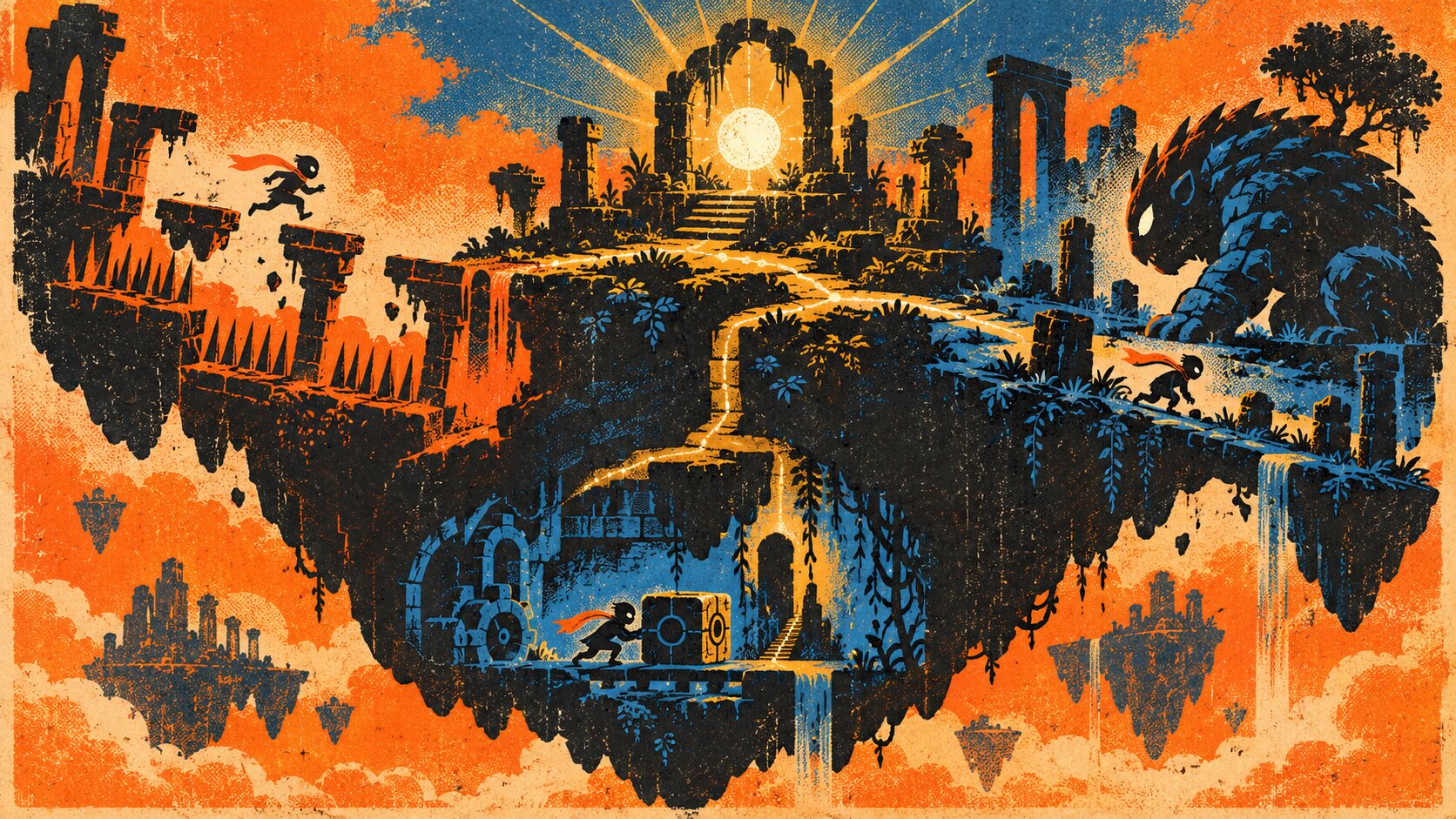
What Replay Value Actually Means
Replay value describes the reasons someone might want to play a game again after completing it or spending substantial time with its central mechanics.
These reasons can vary.
Some players replay games to improve their performance. Others want to experience different stories, discover secrets, experiment with new strategies, or simply enjoy familiar gameplay.
Replayability is not always about starting a completely new save file.
Returning to individual levels, repeating challenges, trying different characters, or exploring alternative choices can all contribute.
Replayability vs. Game Length
Game length and replay value are related, but they aren't interchangeable.
Imagine two hypothetical games.
Game A is a twenty-hour adventure with a fixed story and little incentive to return after completing it.
Game B is a three-hour puzzle game with multiple approaches, optional challenges, and mechanics that remain interesting across repeated attempts.
Game A offers more content during a single playthrough.
Game B may encourage more repeat visits.
Neither experience is automatically superior.
The question is whether you value a long first playthrough, an experience that rewards repetition, or a combination of both.
Replayability Is Personal
A game that offers endless strategic possibilities may have little replay value for someone who dislikes its core mechanics.
Likewise, a short story-driven game might be worth revisiting because of its atmosphere, writing, or emotional impact.
Replay value cannot be measured solely by counting levels, unlocks, or advertised hours.
Why Focused Mechanics Matter
Small independent games often focus on a limited number of interconnected gameplay systems.
This can be a strength.
Instead of supporting dozens of unrelated features, a developer may build an experience around movement, timing, exploration, tactical decisions, or one distinctive mechanic.
When that central system is satisfying, players may continue enjoying it even after they understand the basic rules.
Simple Rules Can Create Complex Decisions
Consider chess.
Its pieces follow a limited collection of movement rules, yet those rules produce an enormous range of decisions.
Video games can use a similar principle.
A tactical game might have relatively few unit types but combine them with changing terrain, positioning, and enemy behavior.
A puzzle game might use only three or four interactive objects while allowing them to influence one another in surprising ways.
A platformer might rely on jumping, dashing, and momentum, with level design creating increasingly demanding combinations.
The underlying system does not need to be large to support meaningful depth.
Mechanical Depth Encourages Mastery
Games become replayable when players can improve at something.
That improvement might involve:
- More precise movement.
- Better resource management.
- Understanding enemy behavior.
- Finding alternative solutions.
- Recognizing strategic patterns.
- Completing challenges more efficiently.
The important element is that greater understanding changes how the game feels.
If a player can return with new knowledge and make noticeably better decisions, repetition has a purpose.
Different Ways Indie Games Encourage Replayability
There is no single formula for a replayable indie game.
Several design approaches can encourage players to return.
1. Meaningful Player Choices
A game can create replay value by offering decisions with noticeably different consequences.
These might include:
- Alternative story paths.
- Different character abilities.
- Multiple problem-solving approaches.
- Competing strategic priorities.
- Distinct endings.
However, choices only strengthen replayability when the differences matter.
Selecting between nearly identical dialogue lines doesn't necessarily justify another playthrough.
2. Skill-Based Challenges
Some games reward repeated play through mastery rather than new content.
A platformer might invite players to complete levels without mistakes.
A rhythm game might reward better timing.
An arcade-style action game might encourage players to improve their scores.
In these cases, the game remains largely the same, but the player's skill changes.
This is particularly effective when controls are responsive and challenges feel understandable.
3. Procedural Variety
Procedural generation can create different environments, item combinations, or encounters between attempts.
That variety can make repeated sessions less predictable.
It is common in roguelikes, roguelites, survival games, and certain strategy titles.
But procedural generation is not inherently a guarantee of replayability.
Random rooms that offer the same decisions repeatedly can become monotonous.
Good replay value comes from meaningful variation rather than randomness for its own sake.
4. Alternative Characters and Playstyles
A game may encourage new attempts through different playable characters, classes, equipment, or abilities.
A ranged character might require a different strategy from a close-combat character.
A deck-building game might encourage experimentation with contrasting card combinations.
The strongest systems provide different ways to engage with the same underlying mechanics.
5. Optional Challenges
Additional objectives can extend a game's appeal without dramatically increasing its size.
Examples include:
- Time trials.
- Optional puzzle solutions.
- Higher difficulty settings.
- Hidden areas.
- Challenge modifiers.
- Alternate completion conditions.
These additions work best when they complement the core experience instead of simply repeating the same activity more often.
6. Multiplayer and Cooperative Experiences
Some compact games become highly replayable through interaction with other players.
The environments or objectives may remain familiar, but cooperation, competition, and unpredictable human decisions create new situations.
However, multiplayer replayability depends on practical factors such as available players, matchmaking, online services, and continued server support.
A multiplayer-focused game may offer less value if its community becomes inactive.
Games That Demonstrate These Ideas
Several recognizable indie titles illustrate different approaches to replayability.
These are examples of publicly documented gameplay mechanics, not rankings or firsthand reviews.
Celeste: Replay Through Movement Mastery
Celeste is a precision platformer built around tightly controlled movement and increasingly demanding challenges.
Its appeal can extend beyond finishing the main story.
Optional levels, collectibles, and opportunities to improve movement encourage some players to revisit earlier challenges.
Its design demonstrates that replayability can emerge from mastering a relatively focused set of controls.
Into the Breach: Replay Through Tactical Decisions
Into the Breach presents tactical encounters where players must consider unit positioning, enemy intentions, terrain, and limited actions.
The game combines relatively compact battlefields with decisions that have substantial consequences.
Its replay value comes partly from exploring tactical possibilities and adapting to different situations.
This is an example of strategic depth without requiring an enormous battlefield.
Slay the Spire: Replay Through Combinations
Slay the Spire combines deck-building with repeated runs and changing encounters.
Card choices, relic combinations, available characters, and encounter conditions influence how each attempt develops.
The attraction lies in experimenting with combinations and learning when particular strategies work.
Its design illustrates how interconnected systems can create variety without needing countless unrelated features.
Stardew Valley: Replay Through Personal Goals
Stardew Valley approaches replayability differently.
Players can pursue farming, relationships, exploration, crafting, and other activities at their own pace.
Some may return to try different farm layouts or personal challenges.
Others may simply enjoy revisiting a familiar world.
This shows that replayability doesn't always require intense competition or repeated failure.
Sometimes a flexible environment encourages players to create their own reasons to continue.
Replayability Isn't Always About Randomness
Procedural generation attracts attention because it can produce different runs.
However, carefully designed fixed content can also be highly replayable.
Think about a well-designed puzzle.
Once you discover its solution, the challenge may become easier.
But if the puzzle supports different methods, tighter constraints, or improved execution, another attempt can still be rewarding.
The same principle applies to platformers, strategy games, and arcade-style challenges.
Designed Variety vs. Random Variety
| Approach | Source of replay value | Potential weakness |
|---|---|---|
| Fixed challenges | Mastery and optimization | Familiarity can reduce surprises |
| Procedural levels | Changing environments | Random variation may feel superficial |
| Branching stories | Different decisions and outcomes | Branches may be too similar |
| Multiple characters | Distinct abilities and strategies | Characters may lack meaningful differences |
| Sandbox systems | Player-created objectives | Some players prefer defined goals |
| Multiplayer | Human unpredictability | Depends on available players or services |
The most effective approach depends on the game's purpose.
A tightly designed puzzle game doesn't need randomly generated puzzles merely to advertise additional replayability.
Likewise, a procedural game benefits from encounters that require genuinely different decisions.
How to Recognize a Replayable Game
Store descriptions often promote words such as "endless," "randomized," and "unlimited replayability."
Those terms should not replace practical evaluation.
Before purchasing, investigate the following questions.
Does the Core Gameplay Look Enjoyable?
If you don't enjoy the basic mechanics, repeating them probably won't make the experience better.
Look for a demo or detailed gameplay footage.
Pay attention to what players actually do during an ordinary session.
Can Different Choices Produce Different Experiences?
A game may advertise dozens of weapons or characters.
But do those options meaningfully change how you play?
Substantial mechanical differences are more useful than large numbers alone.
Is There Room for Improvement?
Games with responsive controls, strategic decisions, or meaningful challenges often reward practice.
If improvement is part of the appeal, look for systems that provide useful feedback.
Does the Game Respect Your Time?
Repetition is not automatically enjoyable.
Consider whether the game introduces meaningful variation or simply requires repeating long sections to reach interesting content.
Shorter sessions and convenient saving can make a game easier to revisit.
Is the Difficulty Appropriate?
A game with excellent systems can still be a poor choice if its difficulty conflicts with your preferences.
Look for information about accessibility options, difficulty settings, tutorials, and how failure is handled.
When Shorter Games Are the Better Purchase
Longer games can provide excellent value, but their size can become a disadvantage when time is limited.
Imagine having only a few evenings each week for gaming.
A compact title with twenty-minute challenges may be easier to enjoy regularly than an enormous adventure requiring lengthy sessions.
Consider the Time You Actually Have
A short game can fit comfortably into a busy schedule.
You may be able to complete its main experience and return for optional challenges without committing to weeks of continuous play.
Consider Your Gaming Preferences
Some players prefer completing a wide variety of experiences.
Others enjoy spending hundreds of hours with one game.
There is no universal answer.
If you prefer variety, shorter games may help you explore more developers, mechanics, and genres.
Consider Your Hardware
Certain smaller indie games have relatively modest system requirements.
That can make them attractive for older computers or handheld devices.
But short length and simple-looking graphics do not guarantee low hardware demands.
Always check the published specifications.
Consider the Total Cost
A compact game can be excellent value at its regular price.
However, the amount of content alone should not determine what you are willing to spend.
Consider how strongly the experience interests you and whether its mechanics appear worthwhile.
Common Replayability Myths
Myth: More Hours Always Means Better Value
A lengthy game that you don't enjoy isn't necessarily better value than a short game you love.
Better approach: Evaluate enjoyment, quality, and personal preferences rather than relying exclusively on estimated hours.
Myth: Random Levels Guarantee Endless Fun
Procedural variation can become repetitive if the underlying decisions rarely change.
Better approach: Look for meaningful combinations, strategic depth, and interesting mechanics.
Myth: Short Games Lack Depth
A compact ruleset can support challenging decisions and substantial mastery.
Better approach: Consider how systems interact instead of counting features.
Myth: Every Game Needs Permanent Upgrades
Some players enjoy progression systems, but others prefer games where improvement primarily comes from learning and practice.
Better approach: Choose the progression style that matches your interests.
Myth: Replayability Requires Multiplayer
Single-player games can offer substantial replay value through branching decisions, strategic combinations, alternate playstyles, and optional challenges.
Better approach: Focus on what changes between sessions and whether those changes remain enjoyable.
Choosing Your Next Indie Game
A useful buying decision starts with identifying the kind of replayability you enjoy.
| If you enjoy… | Look for… |
|---|---|
| Improving through practice | Precision platformers and skill-based challenges |
| Strategic experimentation | Tactical games and deck-builders |
| Unpredictable runs | Procedural adventures and run-based games |
| Exploring alternate decisions | Branching narratives and choice-driven RPGs |
| Personal creativity | Sandbox and simulation games |
| Short repeated sessions | Arcade-style or compact challenge-based games |
Before purchasing, review the game's actual features, system requirements, and available demonstrations.
Avoid buying a title solely because someone advertises hundreds of hours of content.
A good game doesn't need to occupy every free evening.
It needs to offer an experience you value.
Final Thoughts
Small indie games can deliver remarkable replay value because they often succeed through focus rather than scale.
A clever mechanic, a flexible strategy system, or a rewarding challenge can create reasons to return without requiring a gigantic world.
Procedural generation, alternate characters, optional objectives, and persistent progression are useful tools, but none guarantees lasting enjoyment.
The strongest replayability comes from a game remaining interesting after its basic rules become familiar.
For players working with modest gaming budgets or everyday hardware, that creates an opportunity.
Instead of chasing the biggest release, look for smaller games whose core experiences make you want to play again.
Sometimes the smallest games leave the longest impression.
Frequently Asked Questions
What makes a game replayable?
Replayability can come from mechanical depth, alternative strategies, meaningful decisions, procedural variation, mastery challenges, or the enjoyment of revisiting familiar content.
Are short indie games worth buying?
They can be. Value depends on gameplay quality, personal interest, price, and how much enjoyment the experience provides, not just its length.
Do all roguelikes have high replay value?
Not automatically. Run-based mechanics can encourage replayability, but the game still needs engaging decisions and systems.
Can a game without procedural generation be replayable?
Yes. Fixed levels, strategic systems, alternative approaches, and skill-based challenges can support repeated play.
Are smaller indie games easier to run on budget PCs?
Some are, but game size and artistic style do not determine hardware requirements. Always check official specifications.
Is replayability more important than story?
That depends on personal preference. Some players prefer replayable mechanics, while others value a carefully crafted story they may experience only once.
Explore the Featured Games
- Celeste - Official information about the precision platformer.
- Into the Breach - Official information about the tactical strategy game.
- Slay the Spire - Developer website and game information.
- Stardew Valley - Official game website.
By: Marco Medalla
Last updated: October 18, 2026
Editorial Note
Replayability is partly subjective. The examples in this article illustrate publicly described game mechanics and design approaches rather than independently measured playtime, original testing, or guarantees that individual players will enjoy repeated sessions.
0 comments:
Post a Comment